In short
- A lab test checks what your thermometer and your eyes cannot: bacteria on food, surfaces and hands.
- Start with a few tests that match your real risks, not a long list.
- The lab result is only useful if you act on it and write down what you did.
Your thermometer tells you the temperature of a dish at one moment. It cannot tell you whether the cutting board was really clean, whether the cold room is breeding Listeria, or whether the cook's hands carried something onto the salad. A laboratory can. This article is the map of the tests you can ask for, so you know what to order and why.
Tests on food
Most food tests count bacteria, and each one answers a different question.
- Total aerobic count (flora at 30 °C). A general hygiene indicator. A high count says the dish was handled badly or kept too warm for too long.
- E. coli. A sign of faecal contamination, often linked to hands, water or raw produce.
- Salmonella. The classic cause of group food poisoning, mostly from eggs, poultry and minced meat. The usual criterion is absence in a 25 g sample.
- Listeria monocytogenes. Dangerous for pregnant women, older people and people with weak immunity. It grows in the cold, so it matters for ready-to-eat food such as deli meats, soft cheese and mixed salads.
- Staphylococcus aureus. Carried by people. It makes a toxin that cooking does not destroy, so it points at handling after cooking.
- Bacillus cereus and Clostridium perfringens. Linked to cooked rice, pasta, semolina and large pots of sauce or stew that cool too slowly.
Tests on the environment
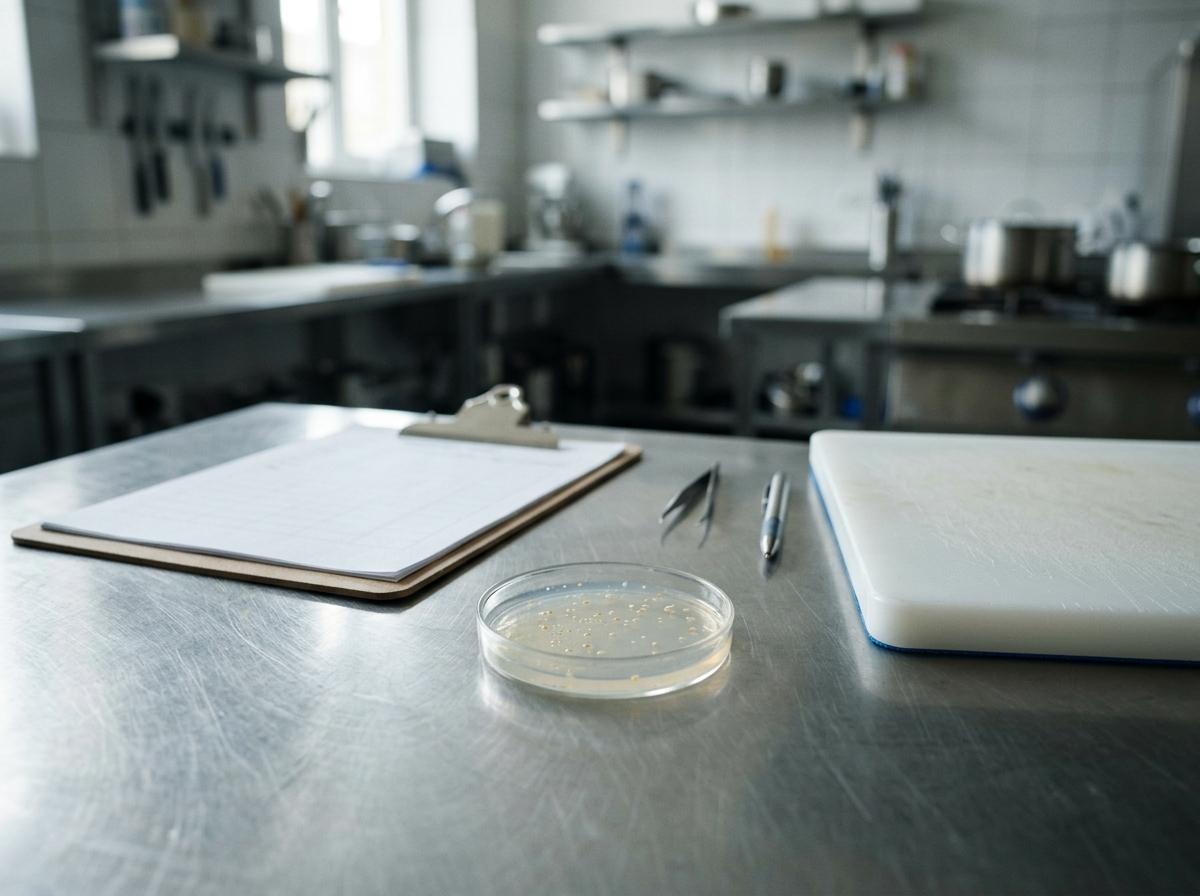
- Surface swabs or contact plates on boards, knives, worktops and slicers. They show whether cleaning really works. See the swab article.
- Hand swabs, taken without warning during service, to check handwashing.
- Water from the kitchen tap or the storage tank. See the water article.
- Legionella in hot water systems, mainly for hotels and accommodation.
- Air, only if you have air handling over a cold preparation area.
Tests that are not about bacteria
Frying oil is checked for polar compounds, a measure of how degraded it is. The oil article covers it. Allergens can be tested on a finished dish or on a cleaned surface, although in the EU the legal duty is first to inform customers about the 14 major allergens (Regulation 1169/2011).
What is required and what is advised
Few rules say "run test X every month". The law, such as Regulation (EC) 852/2004 in the EU and Law 28-07 in Morocco, asks you to control your hazards with a documented system based on HACCP. Regulation 2073/2005 sets microbiological criteria for specific foods. How often you sample is mostly your decision, built from your risk analysis. Your inspector will judge whether it is reasonable. The next article proposes a yearly plan.
A sensible starting set
If you have never tested, begin with four things: one cooked dish served cold or reheated, one ready-to-eat item, five surface points and the water. That is cheap, and it already shows where you stand.
This article is general information, not legal advice. Rules and limits change: confirm the current text with your food safety authority (ONSSA in Morocco, your national authority in the EU) and with your accredited laboratory.
Questions
Are lab tests compulsory for a restaurant?
Rarely as a fixed list. You must control hazards with a documented HACCP-based system, and testing is one way to prove it works. Your authority may ask for specific tests, so ask them.
Which test should I do first?
Surface swabs and water, because they are cheap, quick to read and show immediately whether your cleaning and your supply are sound.
Does a good result mean my kitchen is safe?
No. A test shows one sample on one day. It supports your system, it does not replace temperature control, cleaning and training.